
HARD TIMES HIT HOME
Numbers point to ‘big trouble’ for the finances of both residents and investors
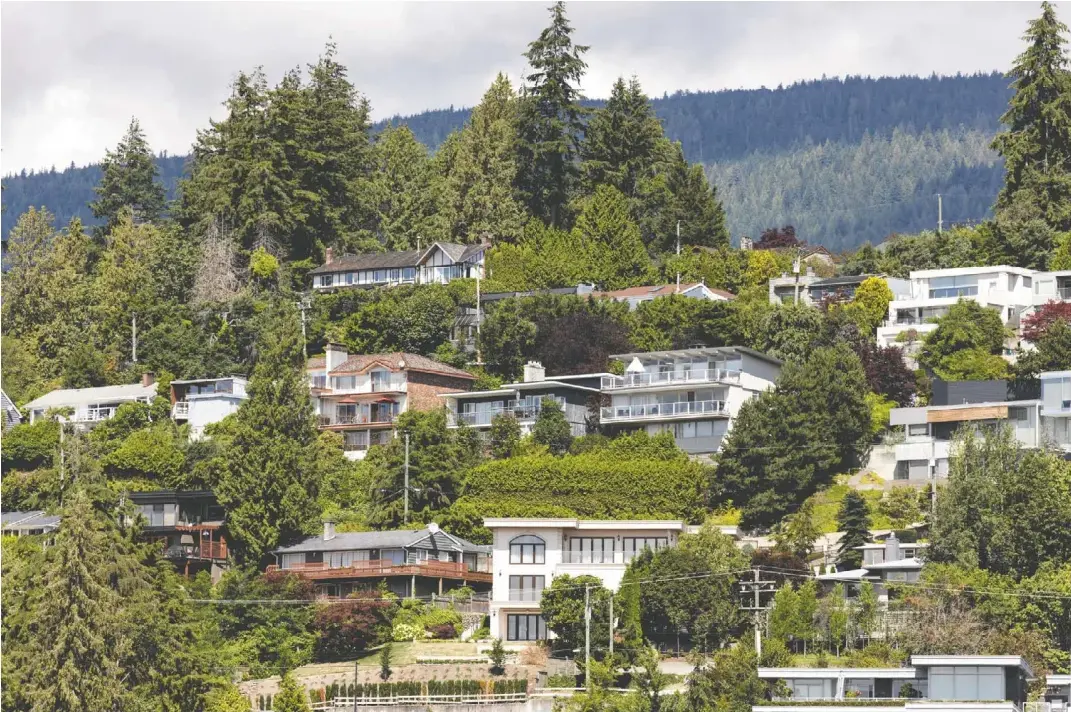
West Vancouver has recorded 295 per cent more court-ordered listings this year compared to the average after the global financial crisis in 2008.

Vancouver Sun
DAN FUMANO
12 Sep 2026
New data from B.C. real estate search platform Zealty shows the annual number of court-ordered home listings in the Lower Mainland has more than tripled over the last three years. The trend indicates `the economy is not in good health,' says Zealty president Hamidreza Etebarian. “Foreclosure day” at the Vancouver courthouse has been a busy scene recently.
Every Monday and Thursday morning, lawyers representing mortgage lenders such as banks bring foreclosure proceedings to B.C. Supreme Court in downtown Vancouver, aiming to force the sale of properties whose owners have stopped making their monthly payments. Homeowners, realtors, prospective buyers, and others often appear as well. It can get crowded.
“You see individual lawyers who regularly appear, they have their binders of papers, sitting at the front table waiting to get through their matters. But then you also are starting to see self-represented homeowners appear, you see potential purchasers and the realtors there. Occasionally, people are looking to snap up a deal,” said Cody Reedman, a Vancouver lawyer who specializes in insolvency and regularly works on behalf of homeowners whose properties have been foreclosed on by lenders.
“Frequently, it starts to spill out into the hallway, and it can be hard to find seating.
“We've had days when our office has gone to court, and there are over 60 matters ... scheduled in foreclosure chambers for a single day in front of a single associate judge,” Reedman said.
Lawyers and realtors working in this area say foreclosure days in court are noticeably busier now than in past years.
Court registries in other B.C. cities have their own designated days for foreclosures, and new stats show a steady increase in foreclosure activity provincewide in recent years. The number of foreclosures initiated by lenders in B.C. has more than tripled over the last five years, according to data from B.C.'S Ministry of the Attorney General, reaching a 10-year-high in the last fiscal year.
New data provided to Postmedia from the B.C. real estate search platform Zealty shows the annual number of court-ordered home listings in the Lower Mainland has more than tripled over the last three years.
“This is an indicator,” said Zealty president Hamidreza Etebarian. “The government depends on real estate for its health and for its GDP. And this basically shows that the economy is not in good health.”
Zealty, which has more than 150,000 monthly users and is affiliated with Holywell Properties real estate brokerage, estimates 2026 could reach a 20-year high in court-ordered listings, which is as far back as the company's data goes and would exceed the peak levels following the 2007-08 global financial crisis.
The company's data shows 773 court-ordered listings last year in the areas represented by the Greater Vancouver and Fraser Valley real estate boards. That was roughly triple the annual average between 2017 and 2022. But the first eight months of this year blew past that number, with 845 court-ordered listings hitting the market between Jan. 1 and Aug. 31.
If the pace of listings for the rest of this year matches the average in the first eight months, 2026 could see more than 1,200 court-ordered home listings, Etebarian estimates. Although the totals also include other legal proceedings, including bankruptcies and family act filings such as divorces, most of these court-ordered listings stem from foreclosures.
The Greater Vancouver and Fraser Valley real estate boards include most of B.C.'S total residential unit sales, encompassing the area from Whistler and Squamish south through the Sunshine Coast, to Vancouver, Surrey and the Metro suburbs east to Mission and Abbotsford. As of this month, Zealty does not have access to data for court-ordered sales and listings in other parts of the province, but data provided by the B.C. Ministry of the Attorney General shows a similar trend played out in foreclosure activity on a provincewide scale over the past 20 years: a surge in the years after the global financial crisis of 2008, followed by a steady decrease between 2012 and 2016, a few years of relatively low levels, and then a steady increase starting in 2022.
The B.C. government's numbers represent all new foreclosure proceedings, including all kinds of residential and commercial properties, filed in B.C. Supreme Court for each fiscal year, and not all of them result in a court-ordered sale.
Zealty's numbers come from a search filter of court-ordered listings for individual homes, which includes houses, condos, and townhouses, but not commercial properties, whole apartment buildings, vacant land or other kinds of estates.
B.C. has also seen a recent surge in developer and commercial receiverships and foreclosures, but Zealty's new data reflects something different, Etebarian said: financial distress at the level of individual residents and investors. The numbers look like “big trouble,” he said.
FORECLOSURES HAVE 'SHIFTED UPMARKET'
Zealty's data shows this wave of court-ordered listings has a different profile and geography from the previous surge more than a decade ago following the financial crisis, Etebarian said.
“There is a big difference between this crisis and the previous one,” Etebarian said. “I would say the '08 cycle was about people losing their jobs. But this cycle is about people who borrowed cheaply at the top of the market, and now they cannot carry the cost.”
Etebarian sees many court-ordered listings for high-end homes purchased in 2020 and 2021 in expensive neighbourhoods, at a time when Canadian interest rates were at their lowest in recent history. As those five-year mortgages came up for renewal last year and this year, this cohort of buyers is facing much higher monthly payments, and many appear to be struggling.
After the 2008 financial crisis, many court-ordered sales appeared in relatively affordable parts of the region such as the Fraser Valley and the Tri-cities, often when middle-class homeowners fell on hard times and struggled to keep up with their payments, Etebarian said.
The new wave of foreclosures has “shifted upmarket,” he said, with the region's most expensive housing markets seeing a surge of activity.
This year, West Vancouver has recorded 295 per cent more court-ordered listings compared to the annual average after the global financial crisis, Zealty's data shows, and on Vancouver's west side, the number has more than doubled.
Meanwhile, hot spots for court-ordered sales after the 2008 crisis, such as Maple Ridge, Pitt Meadows and Port Coquitlam, are recording significantly lower levels than their post-2008 pace.
Etebarian pointed to a 10,000-square-foot, six-bedroom, nine-bathroom mansion with an infinity pool in Vancouver's tony Shaughnessy neighbourhood that went through a $10 million court-ordered sale this summer — less than half the price it was listed for a few years earlier. In the spring, a six-bedroom mansion in West Vancouver's British Properties went through a court-ordered sale of $6 million — more than $1.5 million less than the price the seller bought it for five years earlier.
These examples, Etebarian said, are “the kind of property that simply did not appear on foreclosure rolls during the previous cycle.”
“Back in the day, we wouldn't really see any properties in West Van, or Vancouver West Side, expensive properties being foreclosed . ... Now, it's not all of them, but we do see a lot,” he said.
“These guys that are selling these expensive properties today, they're not middle-class. They are actually wealthy people who (were) living in a $4 million property, and then suddenly they say, `Oh, mortgages are cheap now, let me upgrade to an $8 million property.'”
SHORTFALL
Not every foreclosure filing leads to a court-ordered sale. The process typically works like this: After a property owner has missed mortgage payments for a period of time, the lender contacts the borrower to warn that foreclosure proceedings will be initiated if the arrears are not paid in full before a certain date. After that, the lender's lawyers can start foreclosure proceedings in B.C. Supreme Court, after which a judge will typically give the property owner a chance to pay the full amount owing, plus interest, by a certain date — usually six months. After that period expires, the lender can seek a court-ordered sale of the property to recover the debt.
The whole process — from the first missed payment, to demand letters, to foreclosure filings, to a court-ordered sale hitting real estate listings — often takes close to a year or more.
During B.C.'S previous surge of foreclosure activity, in the years after the 2008 global financial crisis, most foreclosure proceedings that were initiated didn't go all the way to a court-ordered sale, said Simon Clayton, a realtor for 23 years with Macdonald Realty in Vancouver who frequently works on court-ordered sales, usually representing lenders.
In past years, while the real estate market was generally going up, even if a property owner was unable to keep up with their mortgage payments, they could sell the property, pay out the lender, and move on, Clayton said.
“If someone owes a lender $1 million, and their place was worth $1.5 million, and they could quite easily find someone who would give them some money to cover that debt, it pays off the lender, and the proceedings stop.”
That has changed in the last two years, Clayton said.
Now, more foreclosure files are proceeding all the way to a court-ordered sale, he explained, because in today's slow housing market, owners are often unable to sell their properties for the price they paid a few years earlier or, in some cases, even at a price that covers the debt.
“A lot of them are in shortfall,” Clayton said, “which essentially means that the debt is higher than what it can be sold for.”
In some cases, owners are finding themselves in foreclosure court over properties they have owned for decades, but “they've just refinanced them to death, and maybe fallen on hard times,” Clayton said. “I have a lot of empathy for these people because, you know, not everything goes up forever. A lot of the time, they have multiple mortgages registered, and it just adds up, and then there's no equity left.”
Clayton regularly attends foreclosure days at the Vancouver courthouse, and they are noticeably busier lately.
“You can see how busy the courtroom is,” he said. Foreclosures still represent “a small percentage of the overall listings, but there's definitely an increase.”
Properties in foreclosure court are a mix of homeowners' principle residences and properties owned by investors. The investor-owned properties are often mid- to lower-priced condos, where a combination of lower market rents and higher mortgage and insurance payments mean the landlord can no longer cover the monthly cost of owning the unit, Clayton said.
The current situation is not bad news for everyone. Tenants are seeing lower rents, and more choice in the market than they have seen in years.
There could be opportunities for first-time buyers to enter the market when investors are forced to sell homes at a loss, but “the trouble is there's not a lot of confidence when the market's not bounding along,” Clayton said. “Buyers don't have much confidence, so sometimes those opportunities are missed because people are too nervous . ... There's a lot of nervousness in the market in general.”
For homeowners fighting to keep their principle residence, it's “a series of circumstances that have led to, really, an unfortunate situation,” he said.
Clayton would like to see foreclosure levels decrease, but based on broader economic conditions, he believes, “They'll probably remain steady for the foreseeable future.”
“You don't want to see people lose their homes,” he said. “I'd be perfectly happy not having a bunch of court listings.”
`THE MECHANICAL BULL'
A national survey released last month by Royal Lepage found anxiety around mortgage renewals tends to be higher in B.C. than elsewhere in Canada, because the outstanding mortgage balances are often much larger.
The same increase in interest rates that adds a few hundred dollars to a monthly payment in other parts of Canada can have a much bigger impact in Metro Vancouver, the Royal Lepage release said.
Of the respondents who expected their mortgage renewal would create financial strain, more than one-third said they would reduce spending on essentials such as groceries and gas, and almost one in five said they plan to obtain a second job or new source of income, Royal Lepage reported.
In Quebec, Saskatchewan, Manitoba and Atlantic Canada, between 12 and 13 per cent of those respondents said the impending mortgage renewal made them consider changing their living situation, such as selling their home and moving in with family or becoming a renter.
In Vancouver, the proportion was more than 29 per cent.
Mortgage delinquency rates in Canada are still very low as a percentage of all mortgages — less than one per cent in B.C. in the Canada Mortgage and Housing Corp.'s most recent numbers — but they have been rising in recent years.
In May, Equifax Canada reported the growth in mortgage delinquency rates revealed “severe financial strain in high-priced markets,” including a 36 per cent year-over-year jump in B.C. (second only to Ontario).
The present situation in B.C. is a far cry from the much higher mortgage delinquency rates recorded in parts of the U.S. after the 2008 crisis, said Thomas Davidoff, an associate professor of real estate at the University of B.C.'S Sauder School of Business.
“It's still a very low number,” Davidoff said, “but the trend is not our friend. It's not a good direction.
“The current economy (in B.C.) is not great, but it's lethal for the real estate industry. And real estate's a pretty big part of the Greater Vancouver economy.
“It's sort of like riding the mechanical bull. It's tough when interest rates rise and the economy's weak, and there's tariffs, and inflation for stuff you need, and you hold on as long as you can, and eventually you fall off,” Davidoff said. “And there's every reason to think the number of people falling off the mechanical bull of making mortgage payments is going to continue to go up.”
 The data relating to real estate on this website comes in part from the MLS® Reciprocity program of either the Greater Vancouver REALTORS® (GVR), the Fraser Valley Real Estate Board (FVREB) or the Chilliwack and District Real Estate Board (CADREB). Real estate listings held by participating real estate firms are marked with the MLS® logo and detailed information about the listing includes the name of the listing agent. This representation is based in whole or part on data generated by either the GVR, the FVREB or the CADREB which assumes no responsibility for its accuracy. The materials contained on this page may not be reproduced without the express written consent of either the GVR, the FVREB or the CADREB.
Comments:
Post Your Comment: